Diode vs IPL hair removal
Diode laser and IPL are the two most common hair removal technologies in professional equipment, and they are often combined in a single two-function machine. This guide explains how they differ, so buyers can judge whether they need one technology, the other, or both.
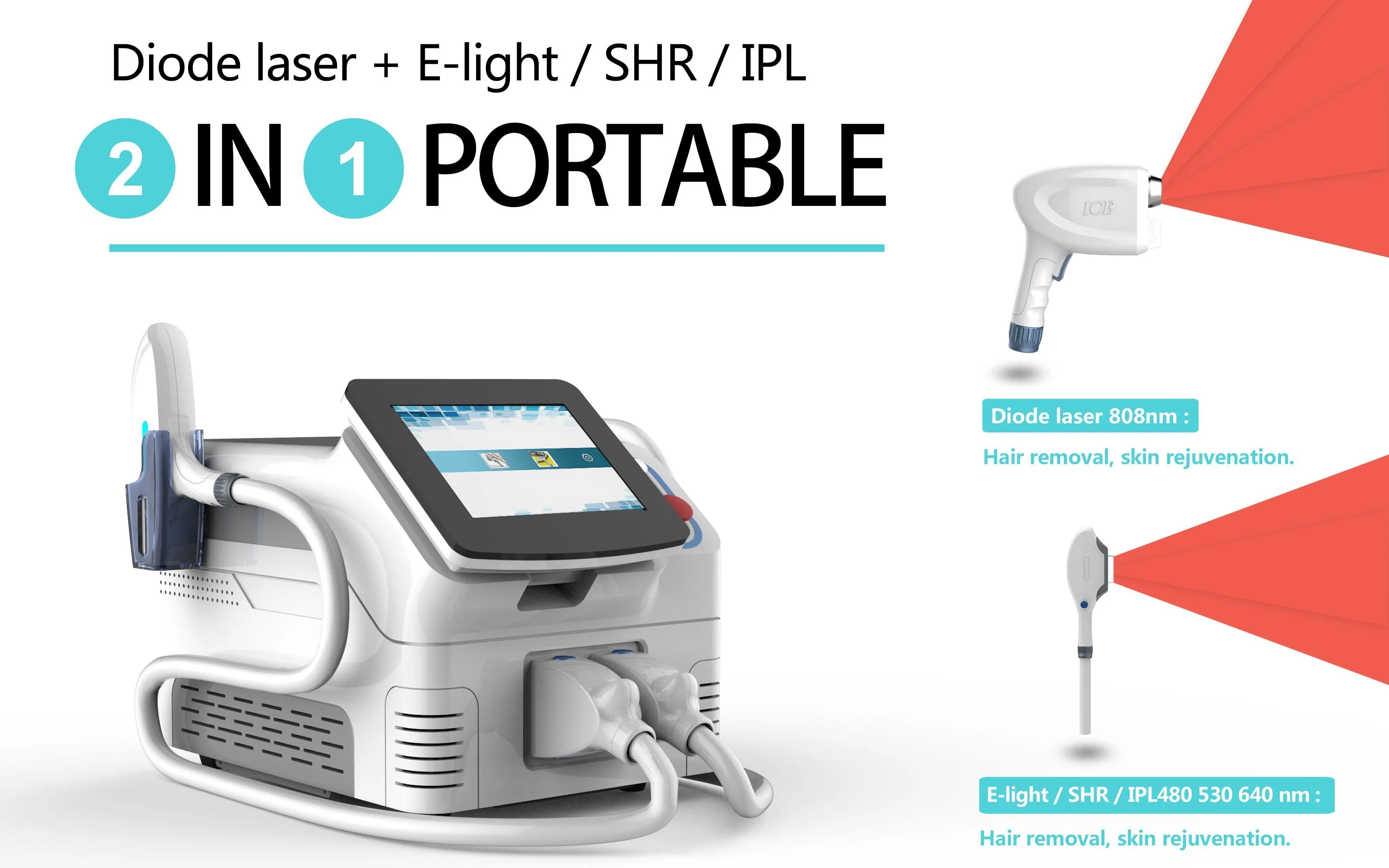
The comparison here is about technology classes, not about brands or models. Individual machines vary within each class, and buyers should confirm the specification of the machine they order rather than relying on the class name alone.
Diode laser hair removal
Diode laser hair removal uses a laser at a specific wavelength — 808nm on the machines described on this site, or a mixed 755nm, 808nm, and 1064nm combination on the DPL4-A2 platform and the big-spot family. A laser delivers light at a narrow wavelength band, which makes its behaviour more predictable from its stated specification.
Diode machines on this site include standalone diode functions, portable diode machines combined with IPL or Nd:YAG, and the big-spot diode family with a triple-wave handpiece. Each of those is described on its own family page.
IPL hair removal
IPL hair removal uses intense pulsed light across a broad wavelength band, shaped by filters into bands such as 480nm to 1200nm, 530nm to 1200nm, and 640nm to 1200nm on the DPL4-A2 platform. Because IPL covers a broad band, its filters and handpieces matter more to the result than they do for a single-wavelength laser.
IPL machines on this site include standalone IPL functions, the portable diode machine combined with IPL, and the SHR mode within IPL equipment. Buyers choosing between diode and IPL should compare the stated wavelengths, spot sizes, cooling, and handpieces of the specific machines, and ask the supplier to confirm each point in writing before payment.